MacBook Neo: A Market Disruptor
Why the MacBook Neo matters, and what a $599 Mac laptop means for the industry.
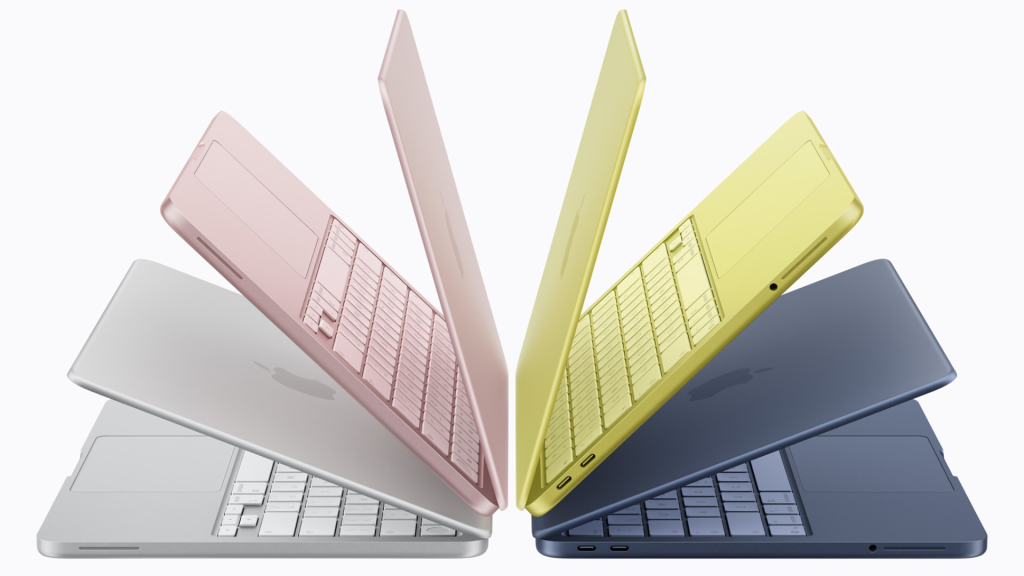
I had just turned 17 when the iPhone 5S launched with the Apple A7 chip - the first 64-bit chip used on a smartphone. Apple claimed 'desktop-class' performance, which frustrated me given how eager I was to unpack that and yet the apps and ecosystem to validate that didn't seem to exist at the time. Fast forward 13 years later and here we have a laptop with a binned variant of a chip originally intended for an iPhone.
This is meaningful for multiple reasons.
A Chip From Your Phone
Chip designers like Intel and AMD have historically produced cut-down variants of desktop-first designs for portable form factors. Apple's design philosophy is the inverse of this, as a mobile-first approach they focus on efficiency and scale up, the result is an entirely different paradigm where the iPhones tend to get the latest iterations of core designs, with the M-series silicon following soon after.
I've seen countless tech enthusiasts and commentors express doubts over the Neo's ability to provide a good desktop experience because it has a 'phone processor', without realising the major advantage Apple has when it comes to their silicon. Benchmarks show historically that Apple's iPhone chips were already competitive with the low-end PC market when it comes to raw performance. Given it's now the same silicon used in an iPhone powering a laptop, we finally have the ecosystem and apps to validate.
To illustrate this, here's how the A11 Bionic (found in the iPhone 8/8 Plus and iPhone X) stacked up against common laptop CPUs you'd find at or below $599 in 2017:
Single-Core Performance (2017)
Scores from cpubenchmark.net. The A11 Bionic is a smartphone SoC, all others are laptop CPUs.
Multi-Core Performance (2017)
Scores from cpubenchmark.net. The A11 Bionic leads in multi-core competing against 15W-class laptop processors.
The $599 Mac
Apple has historically been inaccessible to a wider market due to the high price and anemic configurations at those entry points. The industry is now in a world where Macs in the four digit price range ship with 16GB of unified memory as standard, in a time where memory prices are extremely high due to AI-datacentre demand.
This historical price floor formed a catch-22 situation where developers weren't incentivised to release software for macOS due to the limited userbase, and prospective users were hesitant to dip their toes into the Mac ecosystem because the software they know and love isn't available. The cost and complexity involved parting from the comfortable ecosystem offered by Windows with DirectX and strong vendor support from AMD and NVIDIA was too high to justify developers truly engaging unless they had a high confidence that the Mac userbase would engage.
This MacBook has the potential to break that cycle:
- It's at a price point where many Windows laptops make heavy compromises.
- It is still a premium device with a fantastic build quality.
- The Mac ecosystem already has a proven track record with Apple Silicon, it's not experimental.
To put this into perspective, the best selling laptop on Amazon UK as of March 2026 is the Acer Aspire Go 15, priced at £449 (screenshot). On paper it's compelling: a hex-core Ryzen 5 5625U, 16GB of memory, 512GB SSD, and a 15.6" 1080p panel. More memory, more storage, and it's even upgradable. The MacBook Neo sits at £569.97 on the same page.
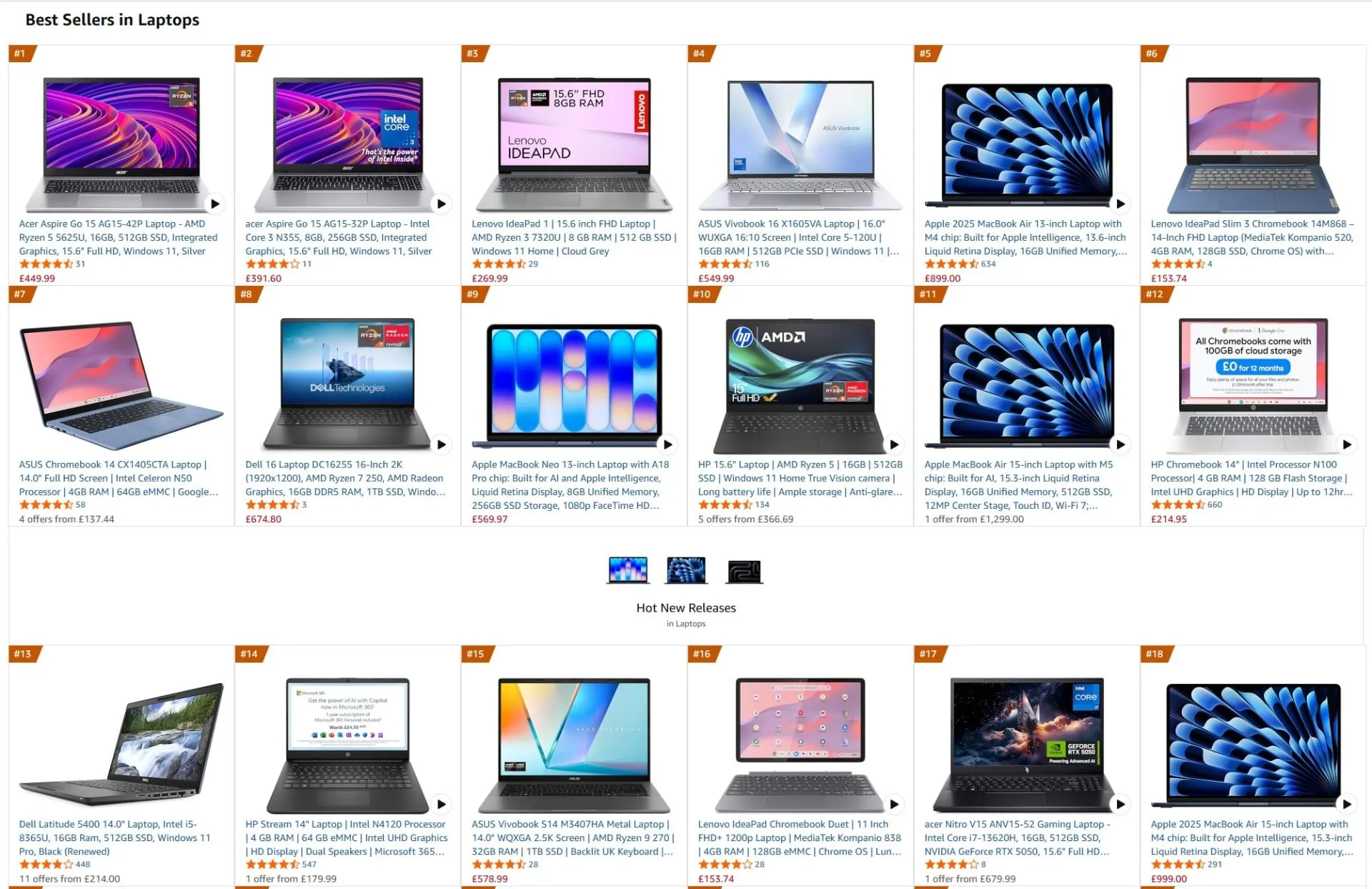
But there's a catch. As Expert Reviews put it, the Acer's display is "wretched", measuring just 246 cd/m² brightness, a contrast ratio of 216:1 at max brightness, and 51.3% sRGB coverage. Other systems in the bestseller category fare better in the screen department, often in favour of lesser chips, but one thing they all share in common is a plastic build that's clearly not made to last.
The Neo, by comparison, ships with Apple's Liquid Retina display, an aluminium unibody, and the entire macOS software ecosystem. At barely £120 more than the UK's most popular laptop, it's not just competitive, it's disruptive.
I genuinely believe this is the most disruptive device Apple could have released, and with trust in Windows as a platform eroding for many due to flaky updates and a push for heavy AI integration, it might be all Apple needs to do to position itself as a viable alternative to Windows laptops for the masses.
What I'm Testing
This review is broken into multiple parts. I'll cover the hardware design, display, benchmarks across synthetic, productivity, and gaming workloads, battery life, connectivity, and a final verdict. Each section has its own page so you can skip to what matters to you.
This review unit is the 512GB Blush model with Touch ID, purchased at full price from Apple. This review was not paid for, sponsored, or influenced by Apple in any way.