MacBook Neo: Synthetic Benchmarks
Cinebench 2024 single and multi-core results for the MacBook Neo's A18 Pro, with live power and frequency telemetry.
Cinebench 2024
Cinebench 2024 is our primary CPU benchmark. It's a pure rendering workload that stresses both single-threaded and multi-threaded paths, making it a good proxy for how the A18 Pro handles sustained compute in a fanless chassis.
Single-Core: 134 pts
The MacBook Neo scores 134 points in Cinebench 2024 single-core. For context, the M5 MacBook Air 15" scores 199 and the M4 Air 15" hits 173. The A18 Pro slots in below the M3 Air, which is reasonable given the thermal and power constraints of this form factor.
The CPU averaged around 3.5W during this test. The chassis remained cool to the touch throughout.
Cinebench 2024 - Single-Core
Higher is better. Comparison scores via Notebookcheck.
Multi-Core: 426 pts
The MacBook Neo scores 426 points in Cinebench 2024 multi-core. That's below the M2 Air's 513, which makes sense: this is a phone chip in a fanless laptop chassis, not a purpose-built laptop SoC. The A18 Pro simply isn't designed for sustained all-core workloads.
These tests were run on battery power, though I saw no meaningful difference in scores when plugged in. The chassis didn't get particularly warm to the touch during either test.
Cinebench 2024 - Multi-Core
Higher is better. Comparison scores via Notebookcheck.
Power Consumption
One of the more interesting things about the Neo is watching how the A18 Pro manages its power budget in a fanless enclosure. During the single-core test, CPU power averaged around 3.5W. The multi-core run was more revealing: CPU power initially peaked at around 6.5W before settling to roughly 4.5W after about a minute, suggesting some light thermal management kicking in. Neither test made the chassis particularly warm to the touch, which is a testament to how little power the A18 Pro actually draws.
Interestingly, running the multi-core test in Low Power Mode (394 pts) didn't meaningfully change the power profile. Combined power still hovered just above 4.5W, suggesting the chip is already operating near its floor in this chassis.
I captured live telemetry during each Cinebench run using powermetrics at 1-second intervals. Use the dropdown to switch between tests.
Cinebench 2024 - Power & Frequency Telemetry
Captured via powermetrics at 1s intervals on macOS.
Storage
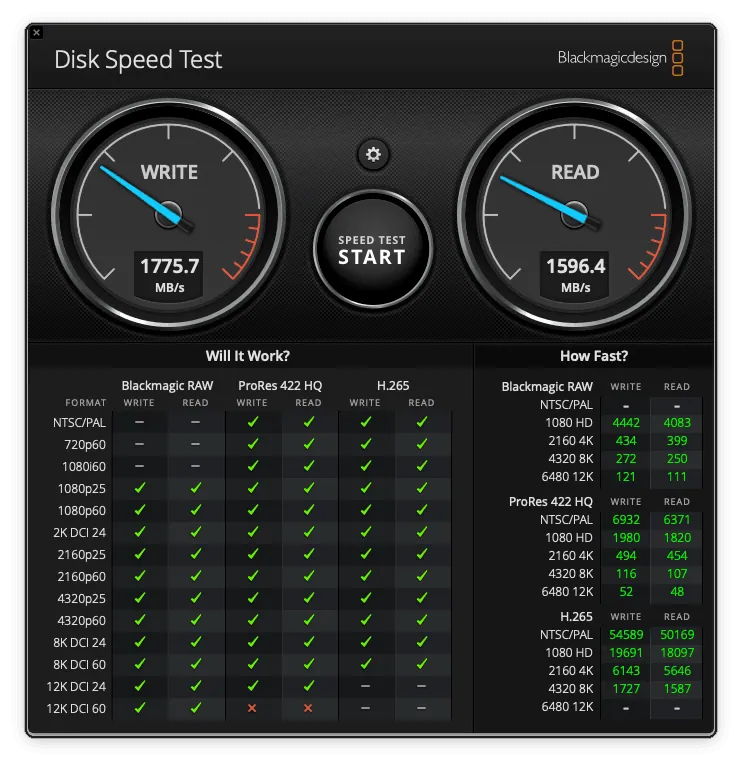
The 512GB model's internal SSD writes at 1,775.7 MB/s and reads at 1,596.4 MB/s. That's slow by modern NVMe standards, but perfectly acceptable for the kind of casual use this machine is designed for. You're not going to notice it loading apps or shuffling documents around.