Mac Mini M6: Value in a Broken Market
What $899 buys in September 2026, and why the M6 Mini still looks like a serious machine against current PC-part pricing.
The Barometer Has Moved
Unless you have been hiding under a rock (if so, lucky you, can I join?) hardware prices have gone somewhere unpleasant. That's a tangent worthy of its own writeup.
You would be lucky to pick up an RTX 5090 for less than €5,000 in Europe at the time of writing.
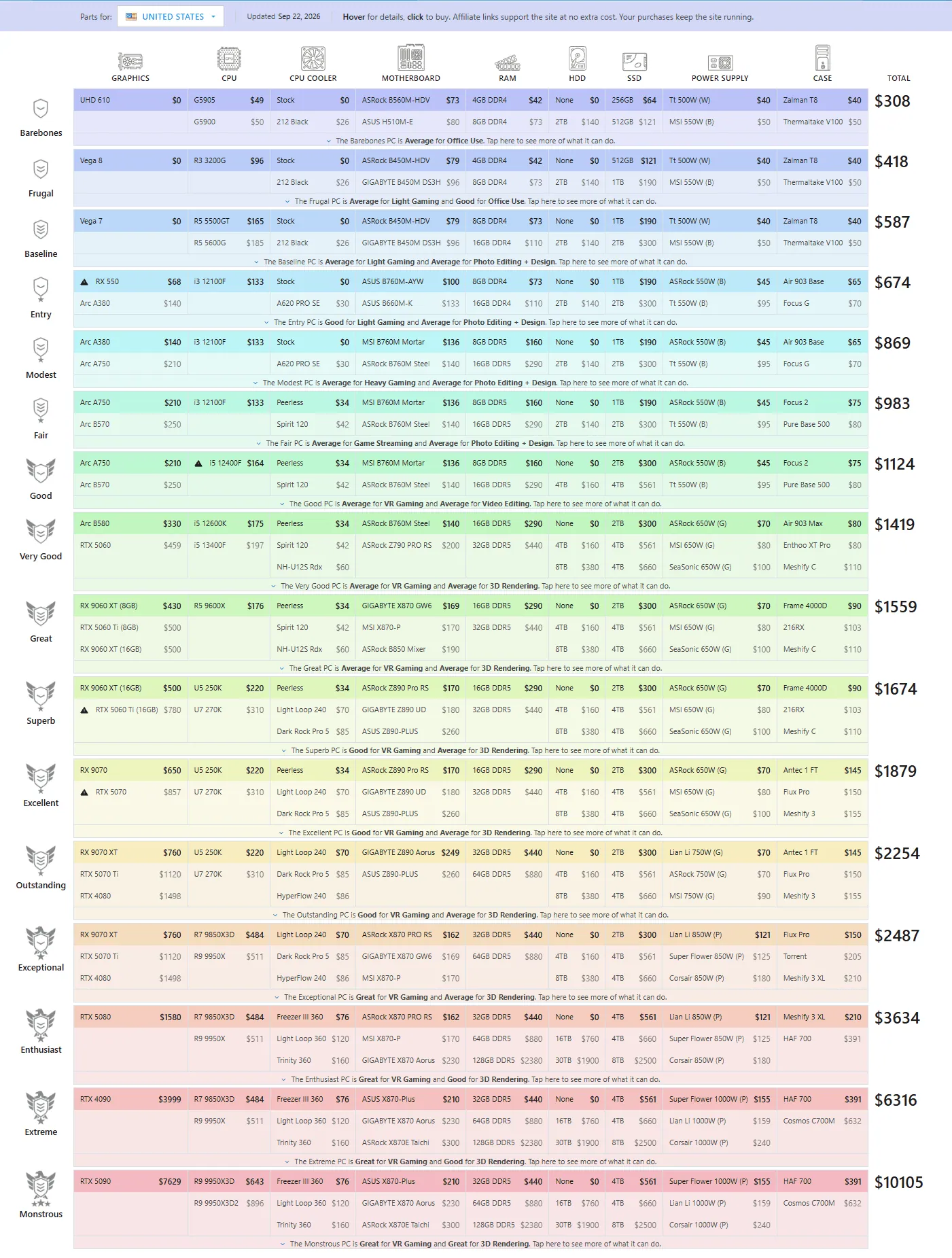
I have always been a fan of Logical Increments, which publishes regional pricing tiers for a PC you would build yourself. Here is a Wayback snapshot, and a screenshot for good measure!
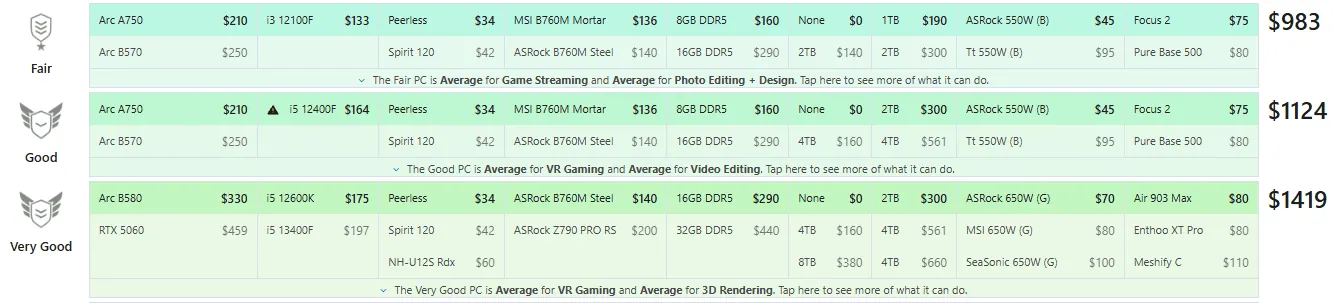
The full screenshot has every tier if you want the whole thing, above just focuses in on the base M6 asking price up to this review cofiguration.
What $899 Buys
The base M6 Mac Mini lists at $899 for 16GB of unified memory and an anemic 256GB system disk, yikes.
At that money, Logical Increments is suggesting an i3-12100F system with an Arc A380, 8GB of DDR5, and a 1TB SSD. A quad-core chip, 8GB of system memory, and a first-generation Intel discrete GPU - granted with a helpful dollop of storage.
TechPowerUp puts that quad-core at about 1,686 Cinebench R23 single-core and 8,560 multi-core, which for the curious is base M2 territory. Tom's Hardware's MacBook Air M2 review had the Air at 8,588 on the first R23 multi-core pass, and the single-core picture sits in the same neighbourhood.
Cinebench R23 multi-core, cited
Higher is better. M2 is Tom's Hardware's first Cinebench R23 multi-core pass on the 2022 Air. i3-12100F is TechPowerUp. Not this bench.
That is unfortunately the $899 conversation right now if you're buying or building a new desktop, a finished 12-core Mac desktop against a four-year-old quad-core parts kit with half the memory. You might find a pre-built setup with a 6GB RTX 3050 and Zen 3 hexa-core part if you're lucky.
The Review Configuration
Even the upgraded 24GB/512GB M6 in this review lists at $1,299 in the US. Logical Increments' $1,419 tier lists an i5-12600K with 16GB of DDR5, a 2TB SSD, and an Arc B580.
The B580 does offer a substantial gaming uplift. GamersNexus observed 79.9 fps at 1080p Ultra without ray tracing, against the M6's 37.5 fps in my Cyberpunk runs. The Windows RTX 5070 desktop reaches 111.11 fps. These are useful reference points, with different renderers and test setups across sources.
With ray tracing enabled, this B580 video at 22:49 shows around 34 fps at 1080p RT Ultra, without upscaling or frame generation. That is just over double the M6 Mini's 16.66 fps, while my RTX 5070 desktop averages 67.66 fps. Going from the teens to the mid 30s is a meaningful improvement, but for a dedicated GPU in this more expensive build, I am still a little underwhelmed.
Cyberpunk 2077, 1080p Ultra, no RT
Higher is better. M6, M4 and M3 Pro are native 1080p Ultra averages from this review (Metal, no upscaling). B580 is GamersNexus at 1080p Ultra, no RT - different renderer and test. RTX 5070 is the Windows desktop on this bench.
The CPU comparison is much more favourable to the Mini. A ComputerBase community result puts the i5-12600K at 109 single-core and 916 multi-core in Cinebench 2024. My 24GB M6 scores 219 and 1,392 respectively, roughly double the single-core score and 52% higher in multi-core.
Cinebench 2024 single-core
Higher is better. M6 (24GB), M4 and binned M3 Pro are this bench. Neo is the published review figure. i5-12600K is a ComputerBase community result from a different test system.
The 12600K's multi-core result sits close to the older M4 and binned M3 Pro, while the M6 pulls well ahead.
Cinebench 2024 multi-core
Higher is better. M6 (24GB), M4 and binned M3 Pro are this bench. Neo is the published review figure. i5-12600K is a ComputerBase community result from a different test system.
The Harder Comparison Is In-House
The DIY market makes the Mini look good, realistically Apple's own lineup does not.
The Mac Mini is no longer the cheapest way into the Mac when buying new. The MacBook Neo starts at $699, or €799 in Ireland, against $899 and €1,079 for the Mini. The Neo includes a display, keyboard, trackpad and battery, and an upgrade to 512GB is just $100 extra.
Matching the Neo's storage costs $200 on the Mini, taking it to $1,099. At that point you are within touching distance of the 13" MacBook Air, which lists at $1,299 with 512GB in its entry-level configuration and, again, comes with a screen.
Apple's 2026 entry points
| Model | Price (USD) | Storage | Memory | Screen and peripherals |
|---|---|---|---|---|
| MacBook Neo (base) | 699 | 512GB | 8GB | Included |
| Mac Mini M6 (base) | 899 | 256GB | 16GB | Supply your own |
| Mac Mini M6 (512GB) | 1099 | 512GB | 16GB | Supply your own |
| MacBook Air 13" (M4) | 1299 | 512GB | 16GB | Included |
US list pricing as of September 2026. The Mac Mini figures exclude a display, keyboard and mouse.
The Mini is a great deal more computer than the Neo there is no question there. But a machine that needs a screen to function, ships with half the storage, and costs more than the laptop is a strange position for Apple to have engineered.
What Matching Configurations Cost
Entry pricing flatters the Mini because the more powerful machines it competes with are not sold in the same shape. We can however match memory and storage across the lineup.
Apple lineup priced at matching configurations
Lower is better. US list pricing as of September 2026. N/A means the configuration is not offered. Mac Mini pricing excludes a display, keyboard and mouse.
The Mini wins every column, and it should, since it is the only machine here that arrives without a screen. But what the chart really shows is how little that discount buys you at the top. The 32GB and 2TB Mini at $2,299 is only (chip aside) $200 below the 13" MacBook Air with the same memory and storage, a decent display, a battery and a keyboard.
A Bitter Pill
The price hike is a bitter pill. The M4 Mini, with 16GB and 256GB, was a phenomenal value at $599 on release. Watching the baseline climb to $899 for the M6 is disappointing, and also understandable.
I do not personally think 256GB is a sensible buy, and the slight hit to memory bandwidth on that entry option is disconcerting. The 16GB machines stay on LPDDR5X-9600, where the 24GB and 32GB move to 10667 and the higher 170GB/s figure. More on that here if you missed it.
All that said, unless you scour the used market, the M6 Mac Mini is a good value against the current component shortages - even in the configuration reviewed today. The generational gains in single-threaded performance and GPU performance on this entry-level chip make it a serious machine.
If Apple had set the baseline storage to 512GB, I think it would be a respectable offering and worth getting excited about, but the current pricing ladder makes the choice much less obvious, and maybe that's the point. Who knows.