Mac Mini M6: Inside the M6 Chip
A closer look at the base M6 chip, its N2 process, memory bandwidth, Neural Engines, and appeal for emulation.
Apple's First N2 Mac Chip
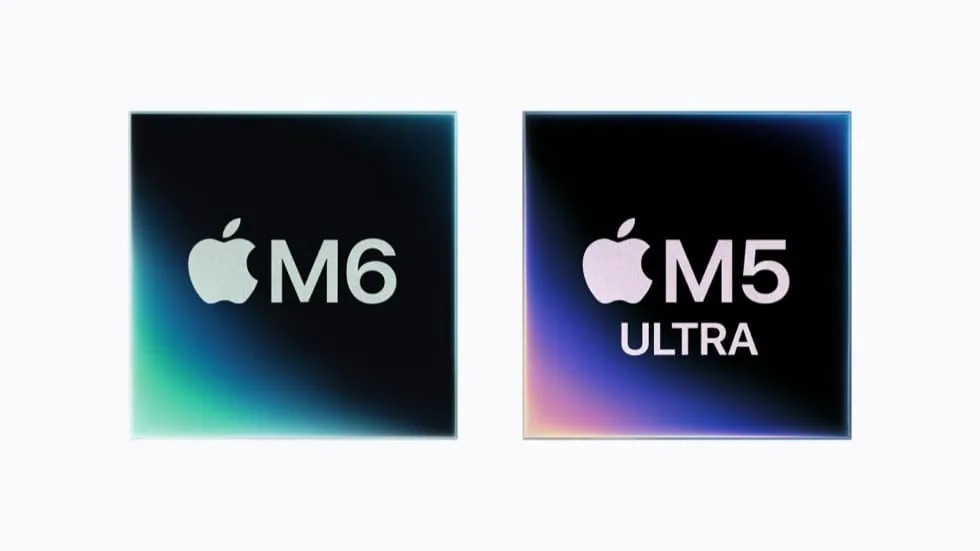
The base M6 is Apple's first Mac chip manufactured on TSMC's 2nm N2 process. It combines a 12-core CPU and 12-core GPU, alongside two 16-core Neural Engines. Apple is heavily promoting Apple Intelligence this generation, and doubling the Neural Engine hardware appears intended to create more capacity for on-device processing.
Importantly that does not make every AI workload twice as fast. Software must target the Neural Engine for it to matter, and many local model tools instead use the GPU through Metal or MLX, which should be helped by neural accelerators on the GPU cores.
What Changed Against the M5?
The 35,789 CPU Mark in my PassMark baseline hides a more interesting spread underneath. Against the M5 10-core figures from CPUbenchmark, the gains are far from uniform. These are one M6 run against an M5 average, with different test builds, so I would treat them as a guide to where the gains land.
PassMark CPU subtests: M5 to M6
| Test | Unit | M5 10-core | M6 12-core | M6 gain |
|---|---|---|---|---|
| Integer Math | MOps/Sec | 56918 | 71418 | +25.5% |
| Floating Point Math | MOps/Sec | 75503 | 88942 | +17.8% |
| Find Prime Numbers | Million Primes/Sec | 300 | 419 | +39.7% |
| Random String Sorting | Thousand Strings/Sec | 35606 | 49700 | +39.6% |
| Data Encryption | MBytes/Sec | 17055 | 23876 | +40.0% |
| Data Compression | KBytes/Sec | 295768 | 412296 | +39.4% |
| Physics | Frames/Sec | 3192 | 4768 | +49.4% |
| Extended Instructions | Million Matrices/Sec | 15065 | 21941 | +45.6% |
| Single Thread | MOps/Sec | 5760 | 6534 | +13.4% |
Higher is better within each row. M6: one PerformanceTest 11.0.1004 run on the 24GB review unit. M5: supplied CPUbenchmark average snapshot; the source labels its suite as V10 submissions. Different systems and test builds, not a controlled architecture comparison.
Single-thread improves by 13.4%, from 5,760 to 6,534 MOps/Sec. The more interesting movement is in sorting, encryption, compression and prime given all improve by about 40%, with extended instructions up 46% and physics up 49%. Integer and floating-point maths move by a more modest 25% and 18% which is to be expected.
The M6 has two more CPU cores, but the gains point towards a more major architectural overhaul. The extra throughput shows up much more strongly in some workloads than others.
Memory Configurations
The base Mac Mini ships with 16GB of LPDDR5X-9600 memory on a 128-bit bus. The 24GB and 32GB configurations use faster LPDDR5X-10667, providing up to 170GB/s of memory bandwidth. My review unit is the 24GB model, so this distinction matters when comparing it with both the base M6 and my 16GB M4 Mac Mini.
170GB/s is importantly more bandwidth than the M3 Pro offered, which I conveniently have to hand. Therefore another comparison system is the entry-level 14" MacBook Pro with the binned 11-core M3 Pro (5 of 6 P-cores enabled, 18GB unified memory), which is a useful laptop-class Pro reference. Token generation on dense models typically correlates against memory bandwidth where not compute-bound, so the comparison seems interesting to me.
Mac Mini M6 Memory Configurations
| Memory | Memory Speed | Bus | Maximum Bandwidth |
|---|---|---|---|
| 16GB | LPDDR5X-9600 | 128-bit | 153.6 GB/s |
| 24GB / 32GB | LPDDR5X-10667 | 128-bit | 170.0 GB/s |
Advertised memory specifications. The threaded-memory result below is from the 24GB review unit.
The PassMark capture puts threaded memory throughput at 159,768 MB/s, or about 160GB/s. Against the advertised ~170GB/s, that is roughly 94%, which is an excellent turnout. The bandwidth is clearly accessible when the CPU puts enough threads to work.
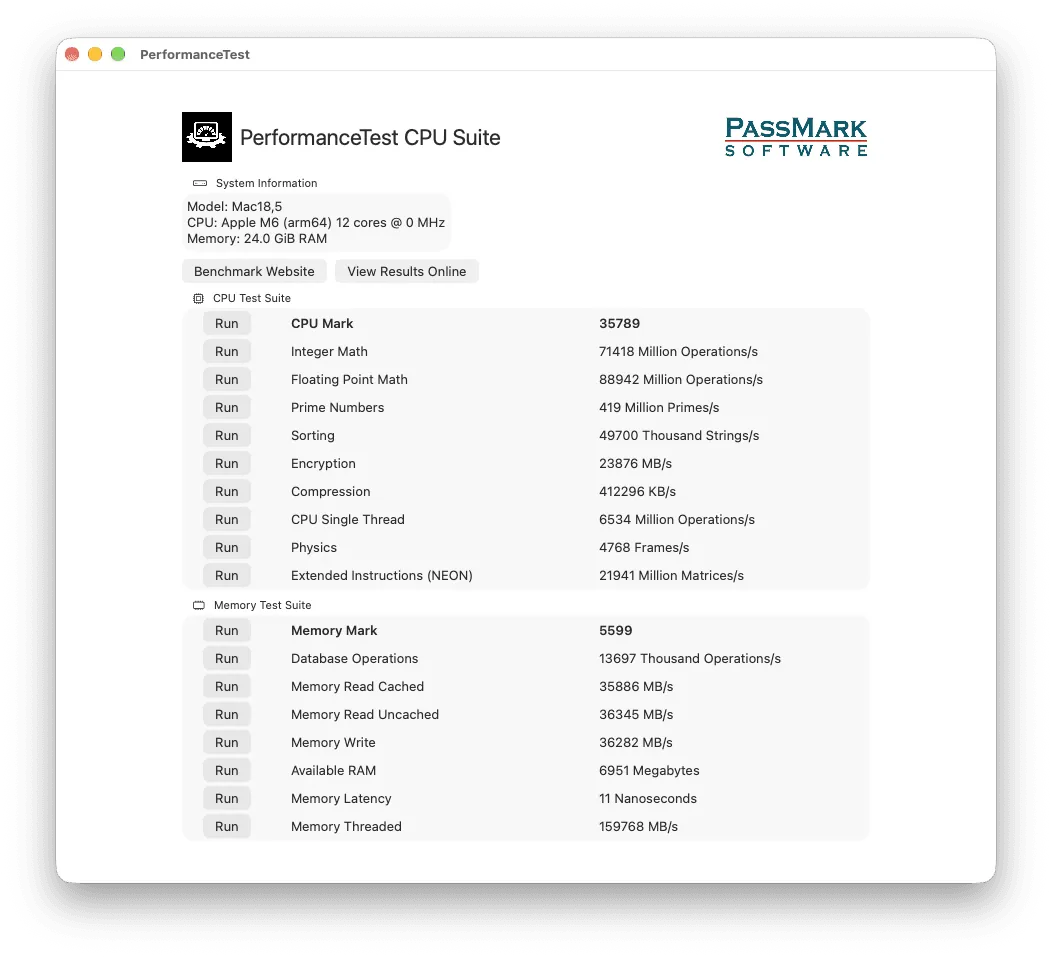
PassMark describes this test as concurrent memory reads, reporting the best result across thread counts. It is frankly encouraging evidence for the memory subsystem as a whole.
A Compelling Emulation CPU
Single-threaded performance is the part I am most interested in, because accurate emulation of old PC hardware places nearly all of its load on one host thread.